
 Myths & Mindsets in a Decade of Electric Transport
We’re excited to announce that for this month’s talk, on Wednesday 25th October, we’ll be hosting the writer, broadcaster and actor Robert Llewellyn (Kryten in Red Dwarf, gameshow presenter of Scrapheap Challenge) for an in-depth exploration of ‘Myths & Mindsets in a Decade of Electric Transport’.
Ten years ago, Robert Llewellyn visited Winchester Skeptics to talk about electric cars. His infectious enthusiasm so transfixed the audience that many cite his talk as the reason they became electric vehicle (EV) owners!
Since then, consumer production models of EVs have become more readily available.
In spite of data which shows EVs are more efficient than fossil fuel vehicles, with reduced CO2, emissions and particulates, in a recent policy U-turn, Prime Minister Rishi Sunak kicked back the date for full transition to EVs to 2035, eliciting heavy criticism from the world’s major car manufacturers, who had already invested billions to meet the original deadline.
There’s also been a significant uptick in anti-EV media headlines. Pervasive stories about EVs have returned. Aren’t they too expensive? Too heavy? With dangerously flawed batteries? Can our energy infrastructure even cope with the demand? Are they really ‘greener’ anyway?
With 2023 global fossil fuel subsidies at a mind-blowing $7 trillion (IMF data) it’s no surprise there’s been pushback.
In this talk, Robert Llewellyn and Dan Caesar aim to get us up to speed on progress during the last 10 years of electric vehicle production. They’ll aim to demonstrate how the barriers to electric transport are primarily psychological, not engineering.
Bio
Robert Llewellyn is a British actor, presenter and writer, famous for his thirty-year stretch as the rubber-masked mechanoid Kryten in the much-loved science fiction comedy, ‘Red Dwarf’. With his interest in engineering, Robert then turned his hand to presenting the long-running TV gameshow, ‘Scrapheap Challenge’ and also ‘How Do They Do It?’ and ‘Carpool’.
In 2010, after being blown away by early Electric Cars, Robert launched Fully Charged, a YouTube channel focussing on the future of electric vehicles, of all shapes and sizes, and clean energy. Fully Charged has exceeded 55 million views around the world and Robert was recently acknowledged as ‘Tech Legend’ at the T3 Awards.
Standard Stuff
Talks are usually on the 4th Wednesday of every month, at 7:00 for 7:30, at The Winchester Club in Winchester. Please take a look at the FAQs for more info.
Admission is £5 which also gives you an entry in the book raffle. We take cash and major cards (cards preferred).
The event is in two parts – the talk and then a Q&A after the interval. We encourage you to support the venue by indulging in the available drinks before and during the event.
You are also welcome to join us for a drink in the bar after the event.
 Do ghosts exist? If not, how are we to explain why so many people believe in ghosts with many of them claiming to have personally had a ghostly encounter?
 QED returns, 23rd-24th September 2023 – with Lucky Cooke, Andrew Smyth, Dan Friesen from Knowledge Fight podcast, and more!
 The rise of AI is a complicated story about advanced research, emerging data oligopolies like Facebook and Google, and big tech venture capitalism. Until recently, the only people who used AI were boffins in University computer laboratories or characters in Hollywood films.
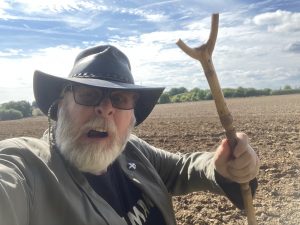 Lockdown was a tough time for many. For freelancers like Stevyn Colgan it meant loss of work and an uncertain future. And so, with the world on hold, he decided to rethink the way he lived. Over the next two years he fixed his physical and mental health and became the happiest, fittest and healthiest he’d been in decades. But the way he did it was by looking back, not forward. He discovered that many of the ‘old ways’ found within folk tradition, witchcraft and druidism actually had strong foundations in science. There’s no woo woo in this talk – Colgan’s contention is that the best way for society to move forward is to learn from the past. Isn’t that the basis of all good science?
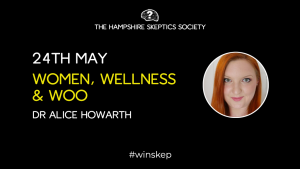 We all want to be well, right? Whether you’re a bit run down and just need a pick me up to get through the next working week, you’re suffering symptoms of a long-standing condition that you just can’t figure out or you’re reaching an age where you want security in your long-term health.
 Why can’t we think straight when hungry? What’s the point of nightmares? And why can’t we forget embarrassing memories?
 We hope to have the one and only Robin Ince to do a talk at Winchester Skeptics later in the year – but in the meantime, you can find him at our favourite bookseller,
  From an evolutionary perspective, religion presents something of a challenge. It is ubiquitous but in some cases religious cognition and behaviour can be costly and even dangerous while (to some) serving no obvious function. So why is religion found in every corner of the globe? Is it just a collection of highly successful memes or a “mind virus” as some dismissively label it? is it the inevitable but largely benign by-product of minds highly evolved for social living? Or are there some real evolutionary benefits to religious cognition?