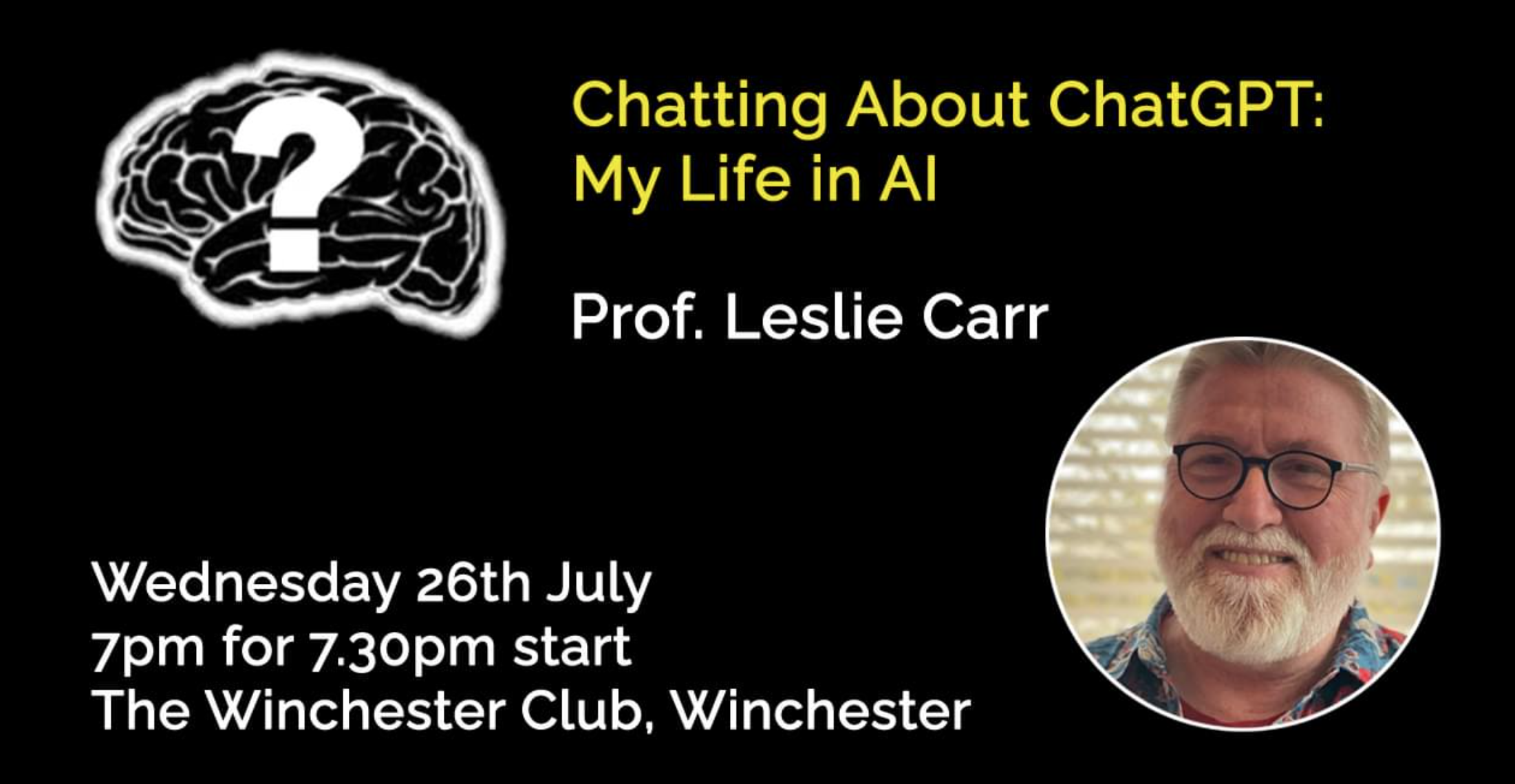
 The rise of AI is a complicated story about advanced research, emerging data oligopolies like Facebook and Google, and big tech venture capitalism. Until recently, the only people who used AI were boffins in University computer laboratories or characters in Hollywood films.
But AI is suddenly affecting everyone with a smartphone and a job. Recent advances in NLP (Natural Language Processing) have led to products like ChatGPT being able to write in a way that is indistinguishable from professional journalists, consultants and researchers.
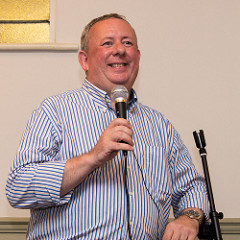
In this talk, Leslie will explain how AI works, what makes it different from normal computing, and whether AIs are really going to steal your job. Also find out how he became an AI professor because of a misunderstanding over Star Trek when he was five years old.
Brief Bio
Professor Leslie Carr is the Head of the Web and Internet Science research group and a Director of the Web Science Institute at the University of Southampton. He started stand-up comedy in 2017 and is a confessional storytelling comedian with a warm and engaging stage presence, performing standup regularly in London and at comedy venues around the South Coast. In 2022 he wrote and performed a show with his daughter, about their family colliding with technology and asking the question “is it easier to teach computers or teenagers to act like humans?”
Standard Stuff
Talks are usually on the 4th Wednesday of every month, at 7:00 for 7:30, at The Winchester Club in Winchester. Please take a look at the FAQs for more info.
Admission is £5 which also gives you an entry in the book raffle. We take cash and major cards (cards preferred).
The event is in two parts – the talk and then a Q&A after the interval. We encourage you to support the venue by indulging in the available drinks before and during the event.
You are also welcome to join us for a drink in the bar after the event.
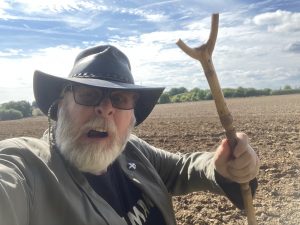 Lockdown was a tough time for many. For freelancers like Stevyn Colgan it meant loss of work and an uncertain future. And so, with the world on hold, he decided to rethink the way he lived. Over the next two years he fixed his physical and mental health and became the happiest, fittest and healthiest he’d been in decades. But the way he did it was by looking back, not forward. He discovered that many of the ‘old ways’ found within folk tradition, witchcraft and druidism actually had strong foundations in science. There’s no woo woo in this talk – Colgan’s contention is that the best way for society to move forward is to learn from the past. Isn’t that the basis of all good science?
 We all want to be well, right? Whether you’re a bit run down and just need a pick me up to get through the next working week, you’re suffering symptoms of a long-standing condition that you just can’t figure out or you’re reaching an age where you want security in your long-term health.
 Why can’t we think straight when hungry? What’s the point of nightmares? And why can’t we forget embarrassing memories?
 We hope to have the one and only Robin Ince to do a talk at Winchester Skeptics later in the year – but in the meantime, you can find him at our favourite bookseller,
  From an evolutionary perspective, religion presents something of a challenge. It is ubiquitous but in some cases religious cognition and behaviour can be costly and even dangerous while (to some) serving no obvious function. So why is religion found in every corner of the globe? Is it just a collection of highly successful memes or a “mind virus” as some dismissively label it? is it the inevitable but largely benign by-product of minds highly evolved for social living? Or are there some real evolutionary benefits to religious cognition?
 Can An Imperfect Movement Save The World?
 Britain has a long and complex migration history, and migration consistently appears as a talking point in politics and the news. Yet the story of Britain is the story of comings and goings, it is a story that underpins our language, economic systems, traditions and cultures. Join Liberty from the